What Changes a Medical Assistant Salary in Dallas?
What Changes a Medical Assistant Salary in Dallas?
Two medical assistants in Dallas can hold the same certification and still see different numbers on their offer letters. A medical assistant salary in the Dallas-Fort Worth area moves with four things you can actually name: the practice setting you work in, the credential you hold, the clinical skills you can document, and the shift you are willing to work.
According to the U.S. Bureau of Labor Statistics, the median annual wage for medical assistants was $44,200 in May 2024, with employment projected to grow 12 percent through 2034 — much faster than the average for all occupations (Bureau of Labor Statistics, Occupational Outlook Handbook, 2025).
Most salary articles stop at that number. This one is about the spread around it — why one Dallas posting lists one range and the clinic three miles away lists another.
Key Takeaways
- The BLS figure is a national midpoint across every state and experience level, not a Dallas starting offer.
- Practice setting is the most visible variable in DFW postings — urgent care, pediatrics, and specialty clinics all hire differently.
- The CCMA credential is what most clinical MA postings in Dallas screen for. It is an employer requirement, not a Texas legal one.
- Documented skills — venipuncture, EKG, injections, EHR charting — are what let you answer a posting’s requirements line by line.
Start With the National Median, Then Adjust for Dallas
A median is a midpoint: half of medical assistants nationally earn above $44,200 and half earn below. It folds together every state, every setting, and every experience level, from a first-week hire to someone with fifteen years in the same practice.
That makes it useful as an anchor and misleading as a prediction. A first job in a small private practice in Denton and a role at a hospital-affiliated specialty clinic in the Medical District are both medical assistant jobs, and both sit somewhere on that distribution — just not in the same place.
The practical move is to read actual DFW postings rather than a single national figure. Postings tell you what local employers are asking for, which is the information you can act on while you are still choosing a program.
Practice Setting Is the Most Visible Variable
Dallas outpatient care is dominated by a handful of practice types, and each one asks for a different mix.
Family medicine and pediatrics run high volume with a wide skill range — you are rooming patients, taking vitals, giving immunizations, and charting all day. Urgent care runs faster and less predictably, and often posts for evenings and weekends. Internal medicine tends toward a steadier panel of patients with more chronic-condition follow-up. Specialty practices — cardiology, dermatology, orthopedics — narrow the skill list but go deeper on it, and often want someone already comfortable with the specific procedures that specialty runs all day.
None of these is universally the better place to start. They are different jobs with different rhythms, and the postings reflect that.
What the CCMA Credential Does in a Dallas Hiring Process
Texas does not license or register medical assistants. No state law requires you to be certified to work as one.
The requirement comes from employers instead, and on clinical MA postings in Dallas it is close to universal. Practically, the NHA Certified Clinical Medical Assistant credential functions as a screen: it is the line in the posting that determines whether a resume gets read at all. Scope of practice in Texas is delegated by the supervising physician, so verify any specific task question with the Texas Medical Board rather than assuming a credential settles it.
Skills That Show Up Line by Line in DFW Postings
Read ten Dallas medical assistant postings and the same list keeps reappearing:
- Vital signs — blood pressure, pulse, respirations, temperature
- Venipuncture and capillary draws, including order of draw
- Electrocardiograms, from lead placement to recognizing a bad tracing
- Injections and medication administration under supervision
- Urinalysis, rapid strep, and blood glucose testing
- Infection control, sterile technique, and wound care
- Patient intake and electronic health record charting
The reason this matters for the pay conversation is simple: a posting’s range usually assumes the person can do all of it on day one. Being able to say yes to each line, with real repetitions behind the yes, is what puts you in the conversation the posting was written for.
Entry-Level and Experienced: How the Arc Usually Runs
The first year is mostly about speed and accuracy — doing the same clinical tasks correctly at clinic tempo, not just correctly. Most new MAs spend it building that.
After a couple of years, the roles tend to widen. Experienced MAs in Dallas practices often take on training new hires, running a specific provider’s panel, handling prior authorizations, or becoming the person who owns a particular procedure in the office. Those are the roles where postings list a wider band, because the band is written for a range of experience.
How to Read a Posted Pay Range
A posted range is a band, not an offer. The top of it is almost always written for someone with several years in that exact setting, the credential in hand, and the full skill list already proven.
Two questions cut through it. First: what does the midpoint assume in terms of years and credential? Second: which of the listed skills are must-have versus nice-to-have? Asking those in a first conversation is normal and tells you more than any national average will.
Where Training Fits in Dallas
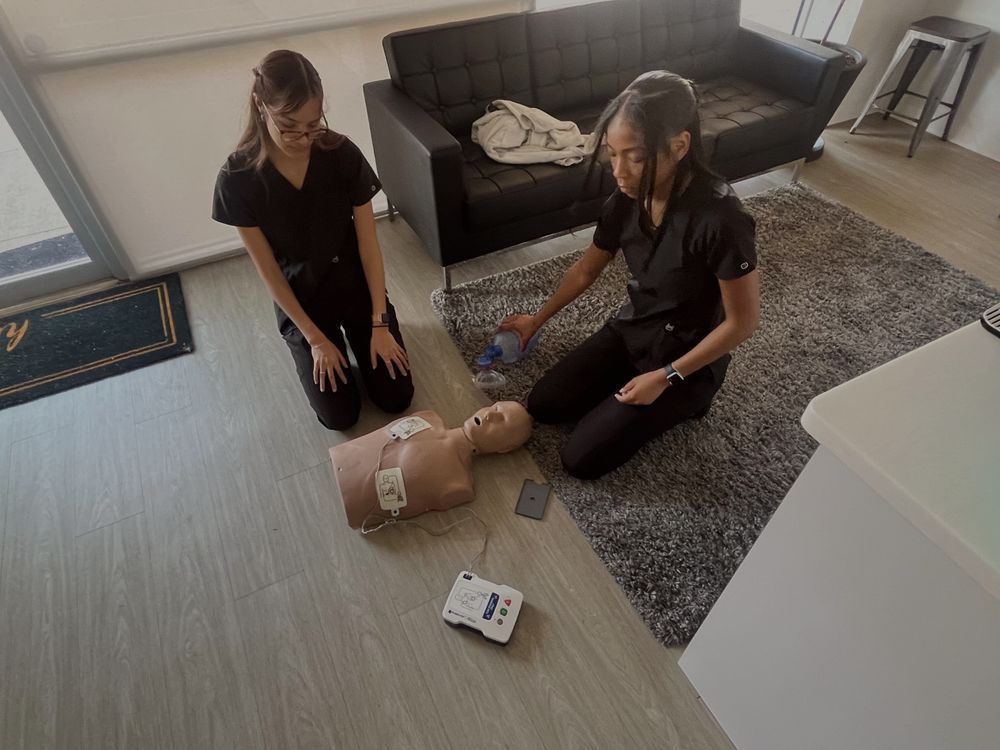
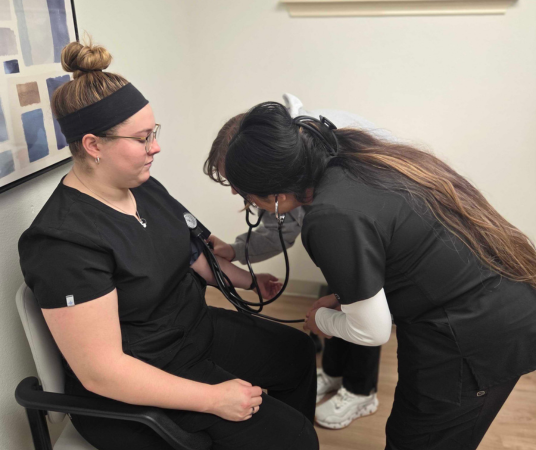
Dallas Medical Assistant School runs an 18-week hybrid program built around the skill list above. Coursework is online during the week; one 4.5-hour lab each Saturday is hands-on practice inside a working medical office rather than a campus classroom. Students become eligible to begin their 80-hour externship after week 8, which is where the clinic-tempo repetitions start.
Renata managed the front office at a Garland auto shop for seven years and had never drawn blood. The Saturday labs were where that changed — not the first one, but somewhere around the fifteenth draw.
Tuition is $4,490, payable in full or through a payment plan: $1,950 down with weekly payments of $157.78 over 18 weeks, or $950 down with weekly payments of $213.33. Current terms are posted on the tuition page. Tuition Savings may be available depending on your start date; ask admissions what applies to yours.
Frequently Asked Questions
Does the BLS median tell me what I would make in Dallas?
Not directly. It is a national midpoint across all states and experience levels. Use it as an anchor, then read current DFW postings for what local employers are actually asking for and offering in the settings you are considering.
Does getting certified change what I am paid?
Certification is not a pay rate. What it does in Dallas is determine which postings you are eligible for at all, since most clinical MA roles list it as a requirement. The pay attached to any specific role is set by the employer.
Which Dallas practice setting should I start in?
There is no single right answer. Family medicine and pediatrics give you the widest daily skill range, urgent care moves fastest, and specialty practices go deeper on a narrower set. Your externship is a useful place to find out which tempo suits you before you commit.
Do I need healthcare experience to start?
No. No prior healthcare experience is required to enroll. The program is built for people coming from other fields entirely, which is most of each cohort.
Getting Started in Dallas
A medical assistant salary in Dallas is not one number — it is a range shaped by setting, credential, and what you can do without supervision. The parts of that you control are the credential and the skills, and both are decided before you ever read a job posting.
Ready to start your medical assistant career in Dallas? Explore the Dallas Medical Assistant School program and take the first step today.
You're only a few months from the medical assistant career you deserve.