How to Evaluate Certified Medical Assistant Classes in Dallas Before You Enroll
How to Evaluate Certified Medical Assistant Classes in Dallas Before You Enroll
Certified medical assistant classes in Dallas are easy to find and hard to compare, because most of them describe the same outcome in nearly the same words. The difference that matters is not what a class covers — it is how many hours you spend with your hands on real equipment, and whether the program puts you in a working clinic before you finish.
This is a comparison guide, not a certification explainer. If you want the credential pathway itself, start with how to become a certified medical assistant in Dallas. This post assumes you already know you want the CCMA and are now deciding where to train.
Key Takeaways
- “Certified” describes you after an exam, not the class — no program can confer the credential itself.
- Hands-on hours and externship timing are the two variables that most separate otherwise identical-sounding classes.
- Ask whether coursework maps to the NHA exam domains, and which domain gets the most time.
- Schedule fit is a real selection criterion, not a footnote — most Dallas students are working while they train.
First, Know What “Certified” Is Actually Describing
A class cannot make you a certified medical assistant. The National Healthcareer Association awards the Certified Clinical Medical Assistant credential after you sit for and pass its exam. A program’s job is to make you ready for that exam and for the clinic on the other side of it.
This matters when you are reading marketing copy. “Certified medical assistant classes” is a description of what the classes prepare you for, not a credential the school issues. Any program describing the credential as something it hands you is worth a second look.
Eligibility for the NHA exam requires a high school diploma or GED plus completion of a medical assistant training program within the last five years, or documented work experience in the field.
Question One: How Many Hands-On Hours, and Where?
This is the question that separates programs fastest, and the one most likely to get a vague answer.
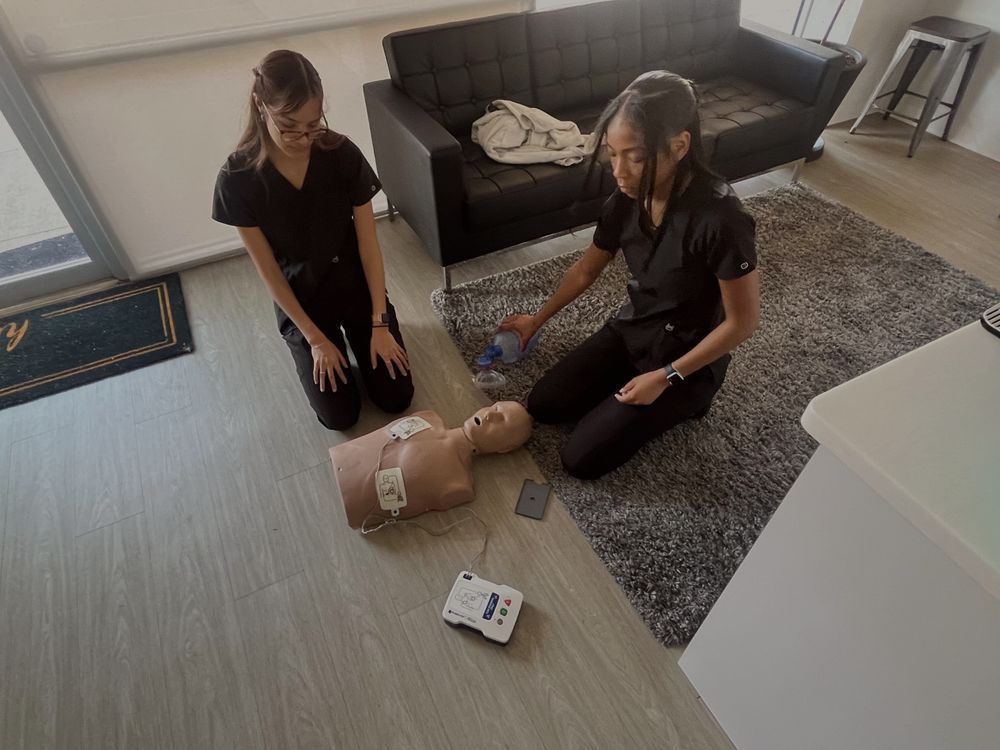
Ask for a number, and ask where those hours happen. There is a real difference between practicing venipuncture in a classroom with a training arm and practicing it in a working medical office with the equipment and workflow you will actually use. Ask how many students share an instructor during those hours.
You do not learn to draw blood by watching one demonstration. You learn it somewhere around the twentieth stick, which means the total number of repetitions a program builds in is a legitimate thing to compare.
Question Two: Is There an Externship, and When Does It Start?
An externship is the difference between finishing a program and finishing a program with clinic experience on your resume. Ask three things: whether there is one, how many hours it runs, and at what point in the program you become eligible.
That last one has practical consequences. An externship happens on weekdays in a working medical office, so if you are employed, you need to know the start date far enough ahead to arrange coverage or shift your hours. A program that puts the externship at the very end gives you less runway to plan than one that opens it partway through.
Ask what kinds of practices students are typically placed in, too. Family medicine, pediatrics, urgent care, and internal medicine make up most Dallas outpatient placements, and they run at very different tempos.
Question Three: Does the Coursework Map to the Exam Domains?
The NHA exam is organized into domains: foundational knowledge, anatomy and physiology, clinical patient care, patient care coordination, administrative assisting, communication, and medical law and ethics.
Clinical patient care is the largest section. A program whose coursework mirrors that weighting — more time on hands-on clinical skills than on any other single area — is aligned with how the exam is actually scored. One that spends most of its hours on lecture content is not, even if it covers every domain on paper.
Ask directly which domain gets the most instructional time. It is a fair question and the answer is revealing.
Question Four: What Does the Schedule Really Demand?
Most people entering certified medical assistant classes in Dallas are working while they do it. So the honest question is not “can I fit this in” but “what specifically does this require of my week?”
Ask what is online and self-paced versus fixed and in-person. Ask how long the in-person commitment runs each time — a four-hour block and a ninety-minute block are different commitments on a Saturday morning. Ask what happens if you miss one.
Then ask about the externship phase separately, because that is usually when the schedule changes shape.
Question Five: What Do You Walk Out With?
Get a specific list. Graduates of Dallas Medical Assistant School receive a certificate of completion and a BLS (CPR) card, and hold the CCMA credential once they pass the NHA exam. Those three items cover the credential line on most Dallas clinical MA postings.
Worth knowing: Texas does not license or register medical assistants. No state law requires the credential. The requirement comes from employers, and in Dallas it is close to universal on clinical postings. That is why the credential matters here even though the state does not mandate it.
Where Online-Only Classes Fit
Online coursework is genuinely good at some things — anatomy, terminology, medical law and ethics, the reading-heavy exam domains. It is a reasonable way to cover that material around a job.
What it cannot do is give you repetitions on a live draw, an EKG lead placement, or an injection. Programs that are fully online leave that gap for you to close on your own afterward, which is a difficult thing to arrange without a clinic willing to host you.
The hybrid structure exists to split the difference: reading and coursework online during the week, hands-on practice in person. At Dallas Medical Assistant School that means one 4.5-hour lab each Saturday inside a working medical office, across an 18-week program, with the 80-hour externship opening after week 8.
Devon spent eleven years in warehouse logistics in Mesquite before enrolling. He did his coursework on weeknights after shifts and used Saturdays for the part he could not learn from a screen.
Tuition is $4,490, payable in full or across a payment plan: $1,950 down with weekly payments of $157.78 over 18 weeks, or $950 down with weekly payments of $213.33. Current terms are posted on the tuition page.
Frequently Asked Questions
Do I need healthcare experience to enroll?
No. No prior healthcare experience is required. Most students come from other fields entirely — retail, food service, logistics, office administration — and start with no clinical background at all.
How long do certified medical assistant classes take in Dallas?
At Dallas Medical Assistant School the program runs 18 weeks, plus the time you take to schedule and sit for the CCMA exam afterward. Other programs vary, so ask for the number of weeks and whether the externship is included in it or added on top.
Can I take the CCMA exam without completing a program?
The NHA allows eligibility through documented work experience in the field as an alternative to program completion. For someone changing careers with no clinical background, the training route is the practical path.
How soon after finishing should I sit for the exam?
Sooner is better. The material is freshest right after you have used it in a clinic, and students who wait several months generally end up re-reviewing content they already knew.
Choosing Where to Train in Dallas
Every program will tell you it prepares you for certification. The five questions above are what turn that shared claim into a comparison you can actually make — hours, externship timing, exam alignment, schedule, and what you hold at the end.
Ready to start your medical assistant career in Dallas? Explore the Dallas Medical Assistant School program and take the first step today.
You're only a few months from the medical assistant career you deserve.